

Table of Contents
- What Actually Drives the Price of a Custom Knife
- Handmade vs Factory Knife Performance: Where the Money Goes
- Benefits of Magnacut Steel and Other Premium Blade Steels
- How to Choose a Custom Knife Maker You Can Trust
- The Value of Heirloom Quality Knives Over Time
- The Secondary Market Reality for Custom Knives
- Who Should Buy a Custom Knife (and Who Shouldn't)
- Conclusion: When Custom Knives Are Worth the Price
- Frequently Asked Questions
Last Updated: September 30, 2026
What Actually Drives the Price of a Custom Knife
A custom knife costs more than a production knife because you are paying for a maker's time, skill, and the hours of hands-on work that go into a single blade. That is the short answer. The longer answer involves steel selection, heat treatment, handle fitting, and the simple fact that one person made your knife instead of a machine stamping out thousands.
At Kīlauea Forge, every blade is hand-made on Kaua'i by owner Joel Snyder, a working law enforcement officer who builds tools for people who carry them into hard conditions. That distinction matters when you are asking whether custom knives are worth the price. The price reflects a specific person's labor, not a factory's output target.
Three factors drive most of the cost:
- Steel choice. Premium steels like Magnacut and Nitro-V cost more per bar than commodity stainless, and they behave differently on the grinder.
- Heat treatment. Getting hardness and toughness right takes controlled equipment and experience. A botched heat treat ruins an otherwise perfect blade.
- Fit and finish. Hand-fitted handle scales, a clean plunge line, and a consistent grind profile take time that production lines skip.
Handmade vs Factory Knife Performance: Where the Money Goes
Handmade and factory knives can both cut well. The difference shows up in consistency, edge retention under hard use, and how the blade holds up after years of sharpening. A production knife is built to a tolerance band. A custom knife is built to one maker's standard.
- Edge retention: depends on steel and heat treat, not on whether the knife is handmade.
- Durability: a full tang custom blade with proper heat treatment handles hard field use well.
- Repairability: custom makers often service their own knives, which matters over decades.
Objective Performance Testing: What the Data Shows
Most comparisons rely on subjective impressions. To get a clearer picture, look at controlled tests that measure edge retention, toughness, and corrosion resistance. Organizations like Knife Steel Nerds publish data on steel performance, but few test finished knives from specific makers.
The Secondary Market Reality for Custom Knives
Custom knives do resell, but the secondary market is not a guaranteed investment. Some makers' work appreciates. Much of it sells at or below the original price. Treating a custom knife purely as an investment is a mistake.
What actually drives resale value:
- Maker reputation. Established makers with long waitlists hold value better than unknown names.
- Provenance. Documentation, original packaging, and a clear build history help.
- Condition. A used, sharpened, scratched knife sells for less than a mint one.
- Demand and scarcity. If a maker stops taking orders, existing pieces can rise in value.
Maker Vetting Checklist
Use this checklist before you commit to a build:
- Can the maker describe their heat treat protocol for the specific steel you chose?
- Do they show work-in-progress photos or video from their own shop?
- Can they explain why they chose a given grind profile for your use case?
- Do they offer a written warranty, and what does it actually cover?
- Are there verifiable reviews or references from other customers?
- Will they service or resharpen the knife later, and how?
- Do they disclose lead times in writing before you pay a deposit?
If a maker dodges the heat treat question or cannot show their own shop, that is a signal. A trustworthy custom maker will talk about their process at length, because the process is the product.
Benefits of Magnacut Steel and Other Premium Blade Steels
Magnacut steel is a powder-metallurgy stainless steel formulated for a balance of toughness, edge retention, and corrosion resistance. That combination is why it has become popular with makers who build knives for wet, salty, or humid environments.
Other premium steels worth knowing:
- Nitro-V: a stainless steel with good toughness and corrosion resistance, often used for hard-use field knives.
- CPM-154: a balanced stainless that sharpens easily and resists staining.
- 3V: a tough non-stainless tool steel, excellent for chopping and heavy use, but it will rust without care.
How to Choose a Custom Knife Maker You Can Trust
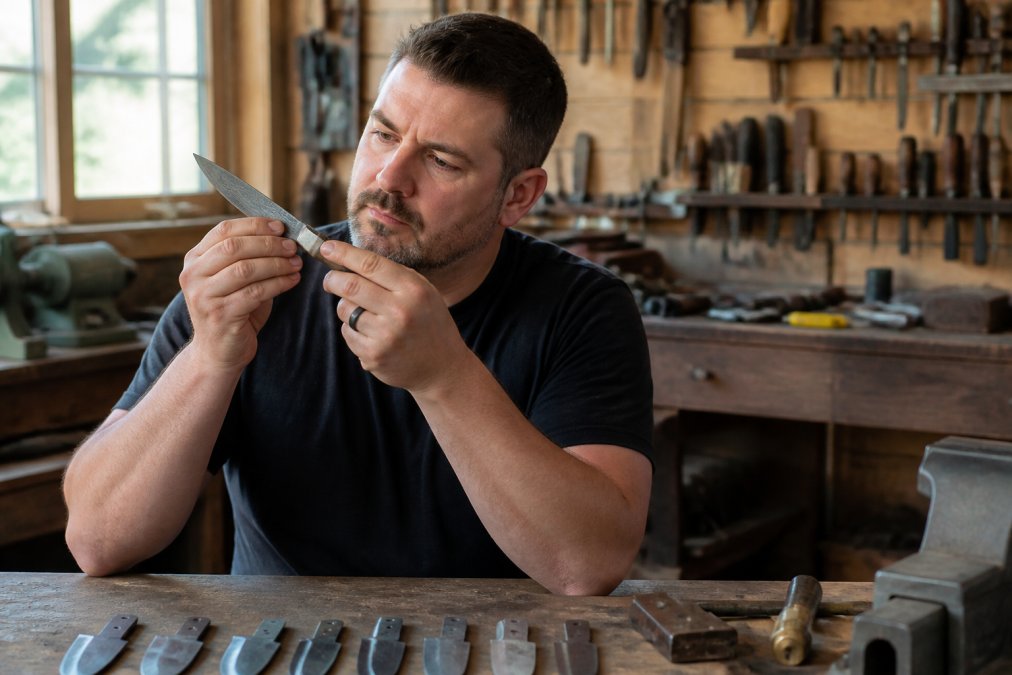
Choosing a custom knife maker comes down to verifying three things: that they actually make the knife themselves, that they can explain their materials and process, and that they stand behind the finished tool. Everything else is marketing.
Maker Vetting Checklist
Use this checklist before you commit to a build:
- Can the maker describe their heat treat protocol for the specific steel you chose?
- Do they show work-in-progress photos or video from their own shop?
- Can they explain why they chose a given grind profile for your use case?
- Do they offer a written warranty, and what does it actually cover?
- Are there verifiable reviews or references from other customers?
- Will they service or resharpen the knife later, and how?
- Do they disclose lead times in writing before you pay a deposit?
If a maker dodges the heat treat question or cannot show their own shop, that is a signal. A trustworthy custom maker will talk about their process at length, because the process is the product.
The Value of Heirloom Quality Knives Over Time
An heirloom quality knife is one built to be used, maintained, and passed down rather than replaced. That standard changes how you evaluate the purchase. You are not comparing it to a knife you will use for three years and discard. You are comparing it to a tool your family might still carry in thirty.
The Secondary Market Reality for Custom Knives
Custom knives do resell, but the secondary market is not a guaranteed investment. Some makers' work appreciates. Much of it sells at or below the original price. Treating a custom knife purely as an investment is a mistake.
What actually drives resale value:
- Maker reputation. Established makers with long waitlists hold value better than unknown names.
- Provenance. Documentation, original packaging, and a clear build history help.
- Condition. A used, sharpened, scratched knife sells for less than a mint one.
- Demand and scarcity. If a maker stops taking orders, existing pieces can rise in value.
Who Should Buy a Custom Knife (and Who Shouldn't)
A custom knife makes sense for people who use a blade hard, want it built to their hand and their work, and plan to keep it for decades. It makes less sense if you want the cheapest tool that gets the job done or if you change knives often.
Buy a custom knife if you:
- Work in demanding conditions where reliability matters, such as field duty or outdoor work.
- Want a blade matched to your grip, your tasks, and your environment.
- Value craftsmanship and plan to maintain and pass down the tool.
- Want ongoing support like sharpening and warranty service from the maker.
Skip a custom knife if you:
- Need a low-cost beater you can lose or abuse without concern.
- Want the same model available off the shelf anytime.
- Are buying purely to resell for profit.
Conclusion: When Custom Knives Are Worth the Price
The honest answer to whether custom knives are worth the price depends on how you use them. If you need a tool built to your hand, made by a specific person, and backed for life, the price reflects real value. If you need a cheap blade for occasional use, it does not.
Frequently Asked Questions
What makes a custom knife different from a factory-made knife?
A custom knife is built one at a time by a single maker who selects the steel, shapes the blade geometry, and finishes the handle to your specifications. Factory knives roll off a production line with standardized specs. The difference shows up in edge retention, fit and finish, and the fact that no two custom blades are identical. You are paying for individual attention at every stage, not just a brand name stamped on a handle.
How do I know a custom knife maker actually forges their own blades?
Ask for process photos or video of your specific build. A legitimate maker will show you the blade at multiple stages: profiling, heat treatment, grinding, and handle fitting. Ask whether they do their own heat treatment or send it out, and to whom. If a maker cannot answer basic questions about steel composition, heat treat protocol, or tang construction, that is a red flag. Visit the shop if you can, or request a video call walkthrough.
Is Magnacut steel worth the extra cost for a working knife?
Magnacut was designed to resist corrosion while holding an edge, which matters if you work in wet or humid conditions. It balances wear resistance, toughness, and corrosion resistance better than many older stainless steels. For law enforcement, first responders, or anyone in a rainforest environment, that combination means less maintenance and fewer surprises in the field. Whether it justifies the cost depends on how hard you use your knife and how much you value low-maintenance performance.
Do custom knives hold their value if I ever want to sell?
Resale value depends on the maker's reputation, the materials used, and whether the knife was a one-off or part of a limited run. Established makers with long waitlists tend to hold value better because demand outpaces supply. Knives with documented provenance, original packaging, and minimal use sell higher on the secondary market. Treat a custom knife as a long-term purchase first and an investment second, because the collector market rewards patience and research.